
Fragmentation vs. Harmonization
Feb 03, 2026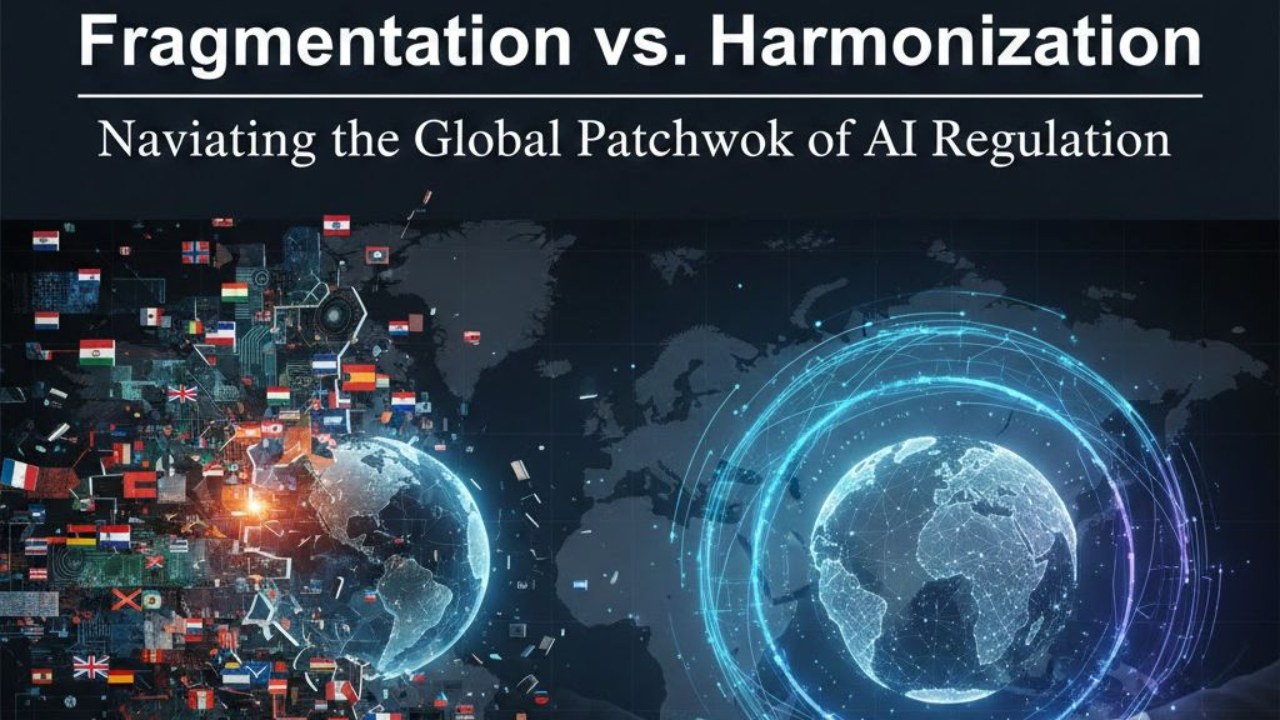
Navigating the Global Patchwork of AI Regulation
Artificial intelligence governance has entered a decisive phase. By 2026, the debate is no longer whether AI should be regulated, but how regulation should be structured across borders, sectors, and levels of government. While international frameworks promise alignment around shared values such as safety, transparency, and accountability, the reality facing organizations today is a fragmented regulatory landscape. Nowhere is this tension more visible than in the contrast between the European Union’s comprehensive AI regime and the increasingly decentralized approach emerging in the United States.
This article explores why fragmentation has become the defining challenge of AI regulation, how partial harmonization is beginning to take shape, and what organizations must do to manage compliance risk in a multi-jurisdictional environment.
The Promise of Global AI Governance Frameworks
Over the past decade, governments and international bodies have worked to establish shared foundations for responsible AI. Frameworks such as the OECD AI Principles and the G7 Hiroshima AI Process emphasize common commitments to human-centric design, transparency, robustness, and accountability.
These frameworks play an essential normative role. They provide a shared vocabulary for policymakers, regulators, and industry, shaping expectations even when they are not legally binding. As a result, they influence how organizations design governance programs and how regulators justify intervention.
However, principles alone are insufficient for managing real-world AI risks. As AI systems move from experimental pilots into critical applications such as healthcare, education, financial services, and public administration, governments are under pressure to translate high-level values into enforceable requirements. This transition from guidance to law is where fragmentation begins to emerge.
The EU AI Act as an Influential Global Benchmark
The European Union has taken the most ambitious step toward binding AI governance through the Artificial Intelligence Act. The regulation introduces a risk-based framework that categorizes AI systems from minimal risk to unacceptable risk, with escalating obligations for developers and deployers.
High-risk systems must meet requirements related to risk management, data governance, technical documentation, human oversight, and post-market monitoring. Certain practices, such as specific forms of social scoring by public authorities, are prohibited outright.
Although the AI Act applies formally only within the EU, its influence extends beyond European borders. Much like the GDPR, it is increasingly functioning as an influential global benchmark. Multinational organizations often find it more practical to align internal AI governance programs with EU requirements than to maintain fragmented compliance regimes across jurisdictions.
This extraterritorial effect is one of the strongest forces pushing the global system toward partial harmonization, even as legal divergence persists.
The U.S. State-by-State Regulatory Patchwork
In contrast, the United States continues to lack a comprehensive federal AI statute. AI governance instead emerges through executive actions, sector-specific regulations, court decisions, and state-level legislation.
Several U.S. states have enacted or proposed laws addressing algorithmic discrimination, automated decision-making, biometric data, and consumer transparency. These laws differ significantly in scope, definitions, enforcement mechanisms, and exemptions. For organizations operating nationally, compliance increasingly resembles a patchwork rather than a unified framework.
This fragmentation creates legal uncertainty and raises compliance costs. It also complicates innovation planning, as organizations may delay or limit deployment of AI systems due to unclear or conflicting obligations. At the same time, state-level action reflects a structural reality - in the absence of federal legislation, subnational governments are responding to public concern and perceived AI-related harms.
Impacts on Multinational Organizations and Innovation
For multinational organizations, regulatory fragmentation presents both operational and strategic risks. AI systems rarely remain confined to a single jurisdiction. Models may be trained in one country, deployed in another, and used by customers globally. Divergent rules on transparency, accountability, and data governance complicate this lifecycle.
Fragmentation can disproportionately affect smaller firms and startups that lack extensive legal and compliance resources, potentially reinforcing market concentration among larger players. Conversely, overly rigid harmonization could suppress innovation if regulatory requirements are poorly calibrated or applied uniformly without regard to context.
Policymakers face a delicate balancing act between protecting fundamental rights and supporting technological progress. Organizations, meanwhile, must navigate uncertainty while maintaining public trust and regulatory credibility.
Paths Toward Partial Harmonization and Practical Compliance
Despite fragmentation, convergence is occurring in practice. International norms continue to influence domestic legislation, even when specific legal requirements differ. Market pressure also drives alignment, as organizations prefer unified internal standards over bespoke local compliance solutions. Regulators themselves increasingly observe and borrow from each other’s approaches.
Leading organizations are responding by aligning governance programs with the most stringent applicable requirements, often drawing heavily from the EU AI Act. This “highest common denominator” strategy reduces long-term regulatory risk and signals a credible commitment to responsible AI.
Effective governance programs typically include centralized AI inventories, documented risk assessments, cross-functional oversight bodies, and continuous monitoring processes. Crucially, governance is treated not as a one-time legal exercise, but as an ongoing operational capability integrated into product development and deployment.
Conclusion
The global AI regulatory landscape in 2026 is defined by tension between fragmentation and harmonization. International principles provide alignment at the level of values, but enforceable rules remain uneven across jurisdictions. The European Union has established a powerful regulatory reference point, while the United States illustrates how decentralized governance can evolve in parallel.
For organizations, the path forward is not to wait for perfect global alignment, but to build adaptable and resilient AI governance structures capable of withstanding regulatory diversity. Fragmentation may dominate the present, but preparation for convergence will shape long-term success in responsible AI.
References
- OECD. OECD AI Principles.
https://www.oecd.org/ai/principles/ - European Union. Artificial Intelligence Act.
https://artificialintelligenceact.eu/ - White & Case. AI Watch: Global Regulatory Tracker - United States.
https://www.whitecase.com/insight-our-thinking/ai-watch-global-regulatory-tracker-united-states - G7. Hiroshima AI Process.
https://www.g7hiroshima.go.jp/en/documents/ - National Institute of Standards and Technology. AI Risk Management Framework (AI RMF 1.0).
https://www.nist.gov/itl/ai-risk-management-framework