
From Rules to Values
Jan 22, 2026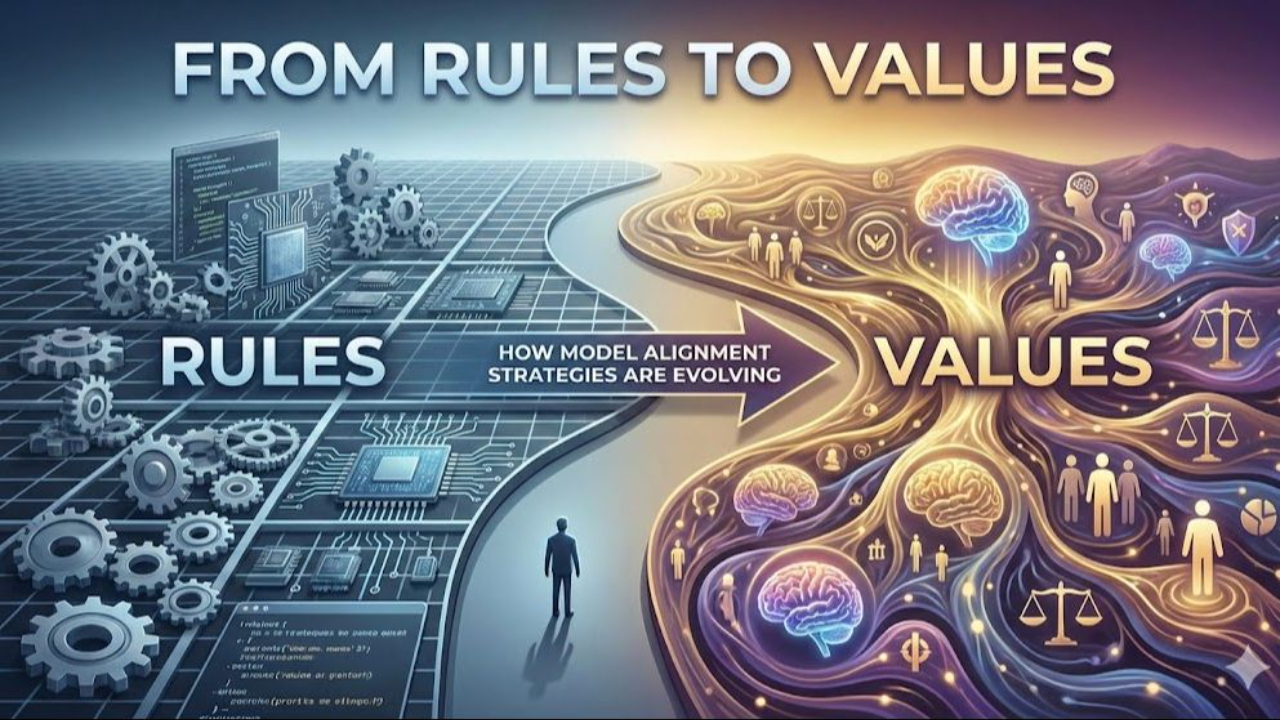
How Model Alignment Strategies Are Evolving
Summary
As AI systems become more capable, traditional rule-based safety approaches are reaching their limits. In response, leading AI developers are adopting values-based alignment strategies that aim to guide model behavior through higher-level principles rather than exhaustive rule sets. This evolution has important implications for AI governance, regulatory oversight, and the future of Responsible AI.
The Limits of Rule-Based AI Alignment
Early approaches to AI alignment relied heavily on explicit rules - for example, fixed refusals, content bans, or predefined lists of prohibited behaviors. While effective for narrow or well-scoped systems, these approaches struggle as general-purpose AI models operate across domains, languages, and complex real-world contexts.
Three structural limitations have become increasingly apparent:
- Combinatorial complexity: It is not feasible to anticipate and codify rules for every possible scenario a capable AI system may encounter.
- Brittleness: Rigid rules can lead to over-refusals in benign situations or unexpected failures in edge cases.
- Static ethics: Fixed rule sets do not adapt well to evolving social norms, cultural variation, or novel use cases.
As models become more context-aware and autonomous, these weaknesses undermine both safety and usefulness, motivating a shift toward more flexible alignment approaches.
Values-Based Alignment Explained
Values-based alignment focuses on teaching AI systems the reasoning behind acceptable behavior rather than enforcing long lists of prohibitions. Instead of asking whether an output violates a specific rule, the model is guided to evaluate its behavior against broader principles such as harm prevention, respect for autonomy, fairness, and proportionality.
Common elements of values-based alignment include:
- High-level ethical or normative principles
- Reinforcement learning from human feedback
- Context-sensitive reasoning rather than binary allow-or-deny decisions
- Internal self-critique or reflection during generation
A prominent example is the constitutional AI approach developed by Anthropic. In this framework, models are trained to assess their own outputs against a written set of guiding principles, enabling more consistent and scalable safety behavior without relying solely on external moderation layers.
Industry Convergence on Hybrid Approaches
In practice, values-based alignment does not replace other safety techniques. Most major AI developers now deploy layered safety stacks that combine:
- Training data curation and filtering
- Reinforcement learning from human feedback
- Automated and human moderation systems
- Principle- or values-guided reasoning
The distinction between rule-based and values-based approaches is therefore one of emphasis rather than exclusivity. Rule-heavy systems prioritize predictability and legal clarity, while values-driven systems emphasize adaptability and generalization. The industry is increasingly converging on hybrid approaches that seek to balance both.
This convergence reflects a broader recognition that alignment is not a one-time technical fix, but an ongoing governance challenge spanning model design, deployment, and post-release monitoring.
Benefits and Risks of Values-Based Reasoning
Benefits
Values-based alignment offers several advantages:
- Scalability: Principles generalize more effectively across domains and languages than detailed rules.
- Reduced brittleness: Models can respond more helpfully in ambiguous or novel situations.
- Human-centered reasoning: Ethical decision-making more closely resembles how humans apply norms in practice.
- Improved transparency: Articulated principles can be documented, reviewed, and debated.
Risks
At the same time, this approach introduces new challenges:
- Value ambiguity: Determining which values are encoded, and whose perspectives they reflect, is inherently political.
- Inconsistency: Principles may be interpreted differently across contexts.
- Cultural bias: Values learned from limited populations may not generalize globally.
- Regulatory uncertainty: Principle-based behavior is harder to audit than rule-based compliance.
These risks highlight why values-based alignment must be paired with robust governance, accountability, and oversight mechanisms.
Implications for AI Policy and Governance
The shift from rules to values challenges traditional regulatory assumptions about deterministic and predictable systems. Values-aligned AI introduces probabilistic reasoning and contextual judgment, requiring regulators to adapt existing oversight tools.
Key policy implications include:
- Auditability: New methods may be needed to assess whether systems reliably apply stated principles.
- Documentation: Clear articulation of model values becomes a governance requirement, similar to model cards or risk assessments.
- Human oversight: Values-based systems still require escalation paths and human-in-the-loop controls for high-impact decisions.
- International coordination: Ethical principles vary across jurisdictions, complicating global deployment.
Frameworks such as the NIST AI Risk Management Framework and the OECD AI Principles already emphasize values like fairness, transparency, robustness, and accountability. Values-based alignment can be understood as a technical attempt to operationalize these policy goals inside AI systems themselves.
Looking Ahead
The move from rules to values signals a maturation of Responsible AI practice. Developers increasingly acknowledge that safety cannot be fully specified in advance and that ethical reasoning must be embedded more deeply into model behavior.
However, values are not neutral. Decisions about which principles guide AI systems are societal choices, not purely technical ones. Transparency, stakeholder participation, and regulatory oversight therefore become even more critical.
If implemented responsibly, values-based alignment may enable AI systems that are more robust, helpful, and trustworthy at scale. If implemented poorly, it risks obscuring accountability behind vague ethical language. The ultimate outcome will depend as much on governance and oversight as on technical design.
References
- Anthropic. Constitutional AI - Harmlessness from AI Feedback.
- Axios. How Anthropic teaches Claude to be good.
- National Institute of Standards and Technology. AI Risk Management Framework.
- Organisation for Economic Co-operation and Development. OECD AI Principles.