
Governing Frontier Models
Jan 13, 2026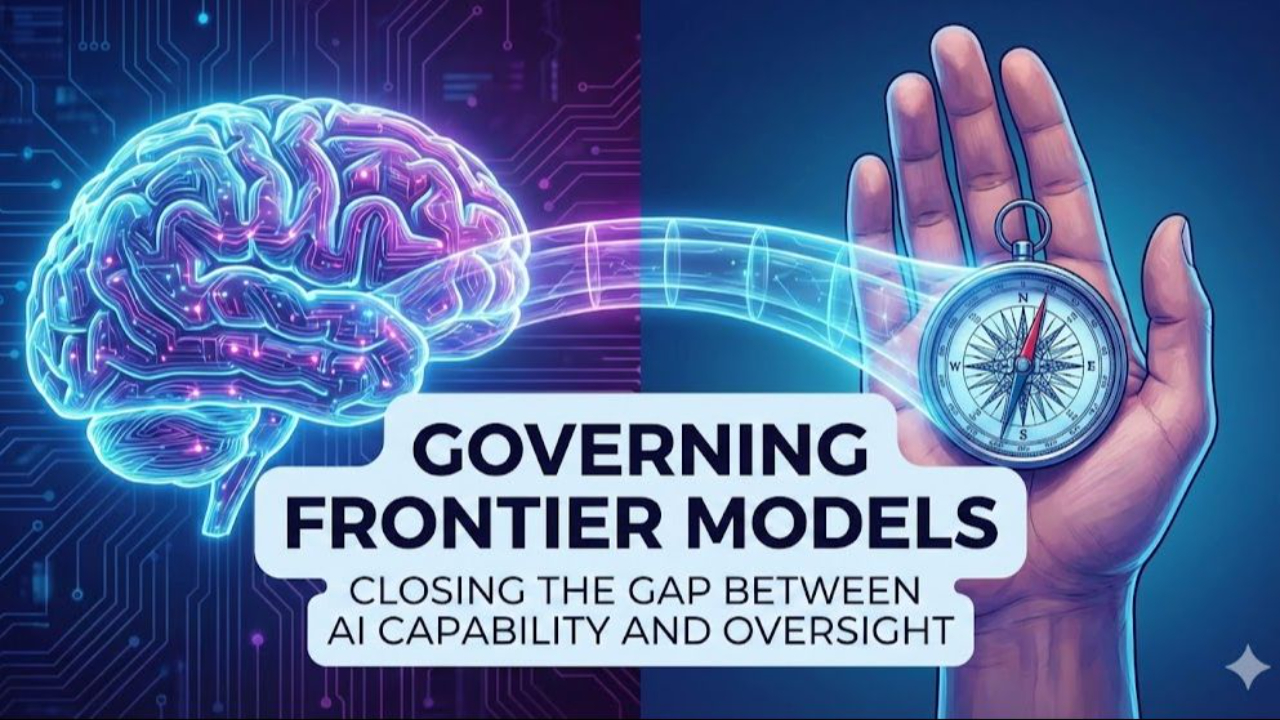
Closing the Gap Between AI Capability and Oversight
Summary
The rapid advance of foundation and frontier AI models is outpacing the capacity of existing governance systems. As international policy bodies warn of growing oversight gaps, governments and institutions face an urgent challenge: how to align accelerating AI capabilities with accountability, risk management, and Responsible AI practices that are fit for purpose.
The Rapid Scaling of Foundation and Frontier Models
AI development has shifted decisively toward large-scale foundation models that can be adapted across domains, tasks, and sectors. These systems increasingly function as general-purpose infrastructures rather than narrow tools. They underpin applications in healthcare, finance, education, public services, and security-sensitive contexts.
This scaling dynamic introduces new governance pressures. Frontier models are trained on massive datasets, deployed across jurisdictions, and updated continuously. Traditional regulatory approaches, which often assume relatively stable systems with clearly defined use cases, struggle to keep pace with this fluidity. As a result, oversight mechanisms designed for earlier generations of AI risk becoming obsolete just as societal reliance on these systems deepens.
Identified Governance Gaps in Public-Sector Oversight
Policy analysis consistently highlights a widening gap between AI capability growth and public-sector readiness. Many governments lack the technical expertise, institutional capacity, and evaluation infrastructure needed to oversee advanced AI systems effectively. Regulatory bodies are often under-resourced and depend heavily on external expertise, including from the organizations they are meant to supervise.
This imbalance creates several risks. Regulators may be unable to independently assess model behavior, safety claims, or systemic impacts. Oversight can become reliant on self-reporting and voluntary disclosures by developers. In addition, governments may struggle to anticipate second-order effects such as labor disruption, information manipulation, or the concentration of power among a small number of AI providers.
Risks of Fragmented Standards and Voluntary Commitments
In the absence of strong oversight, AI governance has leaned heavily on voluntary commitments, ethical principles, and fragmented standards. While these initiatives have helped establish norms, they are not substitutes for enforceable accountability.
Voluntary frameworks often suffer from uneven adoption and ambiguous implementation. Organizations may emphasize transparency while neglecting meaningful risk mitigation, or adopt high-level principles without embedding them into operational decision-making. Fragmentation across jurisdictions further exacerbates these weaknesses, enabling regulatory arbitrage when systems are developed or deployed in the least restrictive environments.
For frontier models with cross-border impacts, this patchwork approach is especially problematic. Risks such as misinformation, bias amplification, or emergent harmful behaviors do not respect national boundaries, yet governance responses frequently remain siloed.
The Role of International Coordination and Shared Evaluations
To address these challenges, international organizations increasingly emphasize coordination and shared evaluation mechanisms. Common standards for model documentation, risk assessment, and reporting can reduce duplication, improve comparability, and strengthen collective oversight capacity.
Shared evaluation infrastructure is particularly important for frontier models, whose scale and complexity exceed the capacity of many individual institutions to assess independently. Coordinated red-teaming, benchmark development, and post-deployment monitoring can help surface systemic risks earlier and distribute oversight responsibilities more equitably.
International cooperation also serves a normative function. By aligning expectations around transparency, accountability, and safety, governments can send clearer signals to developers and reduce incentives for regulatory evasion.
Policy and Responsible AI Pathways to Regain Control
Closing the governance gap does not require indiscriminately slowing innovation. Instead, it requires adaptive, lifecycle-based oversight grounded in Responsible AI principles. Key pathways include:
- Embedding risk management across the AI lifecycle, from data sourcing and model training to deployment and continuous monitoring
- Strengthening institutional capacity within regulators and public-sector bodies
- Mandating meaningful transparency focused on decision-relevant information rather than symbolic disclosures
- Aligning voluntary ethical frameworks with enforceable legal and regulatory obligations
- Investing in shared public infrastructure for evaluation, auditing, and incident reporting
Ultimately, governing frontier models is not solely a technical challenge. It is an institutional one. Without deliberate investment in oversight capacity and coordinated governance, the gap between AI capability and societal control will continue to widen.
References
- OECD. Artificial Intelligence Policy Observatory - Foundation Models and Generative AI.
https://oecd.ai - OECD. AI, Trust, and Public Governance.
https://www.oecd.org/gov/digital-government/ - National Institute of Standards and Technology (NIST). AI Risk Management Framework (AI RMF 1.0).
https://www.nist.gov/itl/ai-risk-management-framework - NIST. Generative AI Profile (AI RMF Companion Resource).
https://www.nist.gov/itl/ai-risk-management-framework/generative-ai-profile - European Commission. EU Artificial Intelligence Act - Regulatory Framework and Implementation.
https://digital-strategy.ec.europa.eu/en/policies/european-approach-artificial-intelligence - G7. Hiroshima AI Process - Guiding Principles for Advanced AI Systems.
https://www.g7hiroshima.go.jp