
The Real Reason AI Isn’t Scaling:
Mar 17, 2026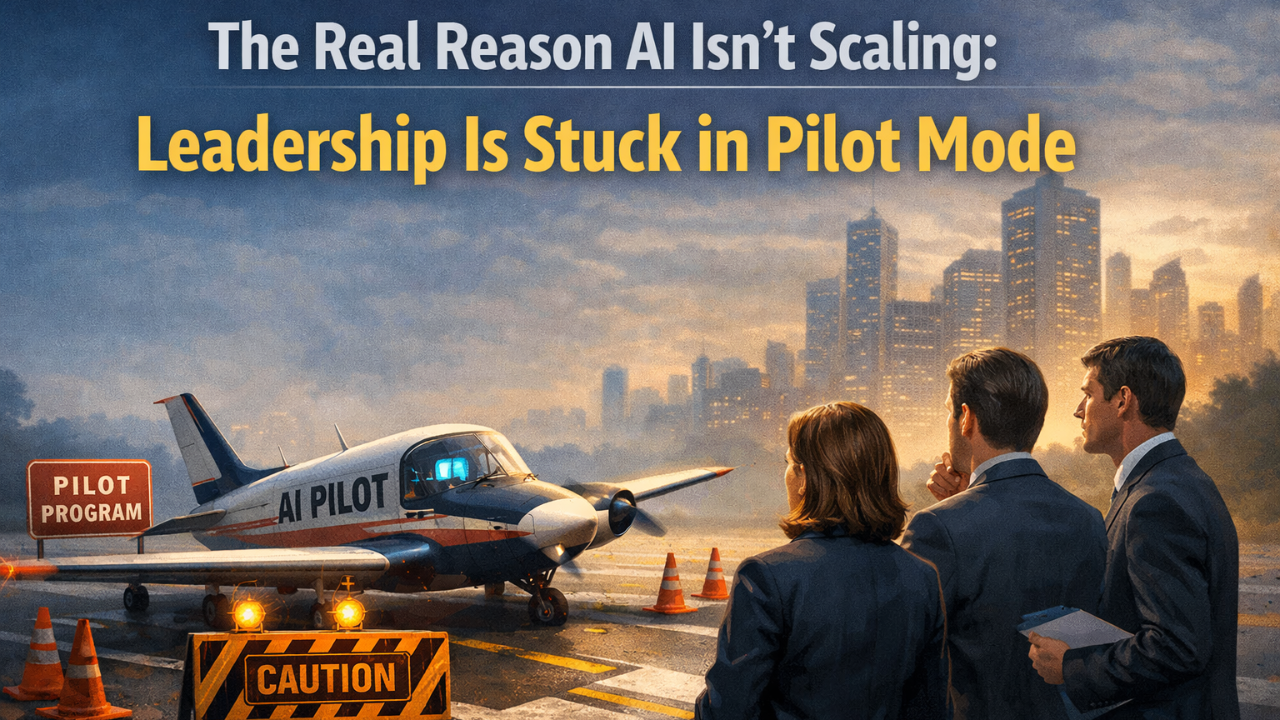
Leadership Is Stuck in Pilot Mode
You’ve seen this play out.
A business unit launches a promising AI use case. Maybe it’s a forecasting model, a GenAI assistant, or a pricing optimization tool. It works - at least in isolation. There’s a demo. Stakeholders nod. Someone calls it a success.
Then nothing happens.
Six months later, you’ve got 15 “successful” pilots across the organization - and no measurable shift in how decisions are made, how teams operate, or how the business performs.
This is where most organizations are right now.
According to McKinsey, nearly every company is investing in AI, but only 1% consider themselves mature in how they use it [1]. That gap isn’t about tools or talent. It’s about how leadership is behaving.
Most organizations aren’t failing at AI.
They’re stuck in pilot mode.
AI Everywhere, Impact Nowhere: The Pilot Trap
On paper, things look good.
There’s activity everywhere:
-
Data science teams are building models
-
Business teams are experimenting with GenAI
-
Vendors are being onboarded
-
Use cases are multiplying
From the outside, it feels like progress.
But when you look closer, something’s off.
The same use cases never scale. Each team is solving similar problems in parallel. Outputs aren’t consistently used in real decisions. And no one can clearly point to where AI is changing business outcomes at scale.
This is the pilot trap.
Pilots are designed to answer: Can this work?
But organizations quietly start treating them as proof that this is working.
Those are not the same thing.
And once leadership accepts pilot success as sufficient, the pressure to operationalize disappears.
Why Leadership Defaults to Experimentation Instead of Commitment
This pattern isn’t accidental. It’s structural.
For most leadership teams, staying in pilot mode feels rational.
Pilots are:
-
Low risk
-
Funded incrementally
-
Easy to approve
-
Easy to stop
Scaling, on the other hand, requires something very different:
-
Cross-functional alignment
-
Workflow redesign
-
Clear ownership of outcomes
-
Willingness to standardize and enforce usage
That’s where things break down.
Because scaling AI isn’t a technical step - it’s an operating model decision.
And leadership alignment is consistently identified as a leading blocker to AI adoption [1].
So instead, many organizations keep funding more pilots. It creates the appearance of momentum without forcing the organization to change how it actually works.
The Cost of Staying in Pilot Mode: Fragmentation, Fatigue, and Lost Trust
Pilot mode doesn’t just slow you down. It creates compounding problems.
1. Fragmentation
Different teams build similar solutions with different data, logic, and definitions. There’s no shared foundation, and no consistency in outputs.
2. Fatigue
Business stakeholders get exposed to a constant stream of “new” tools and models - but very few become part of their daily workflow. Over time, engagement drops.
3. Lost trust
When outputs aren’t consistently used - or when different models produce conflicting answers - confidence erodes. Teams revert to intuition or legacy processes.
This is how organizations end up with strong technical capability and weak adoption at the same time.
And once trust is lost, scaling becomes significantly harder.
What Decisive Leadership Looks Like in AI Adoption
Breaking out of pilot mode requires a shift in how leadership shows up.
Not in vision statements - in decisions.
Decisive leadership in AI adoption looks like this:
1. Clear ownership of adoption, not just delivery
Someone is accountable not just for building models, but for ensuring they are used in real decisions.
2. Fewer use cases, deeper commitment
Instead of 20 pilots, leadership prioritizes 3-5 high-impact areas and commits to fully embedding them into workflows.
3. Standardization over customization
Teams align on shared definitions, metrics, and logic - even when it’s uncomfortable.
4. Enforced usage in decision processes
AI outputs are not optional. They are built into how decisions are made, reviewed, and governed.
5. Measurement tied to business outcomes
Success is not model accuracy. It’s changes in revenue, cost, risk, or decision speed.
This is where most organizations hesitate.
Because these moves require saying no, creating constraints, and holding teams accountable in new ways.
But without them, adoption doesn’t happen.
Shifting from Optional Use to Embedded Workflows
The real transition is this:
From AI as a tool people can use
To AI as part of how work gets done
That shift happens at the workflow level.
For example:
-
A forecast isn’t just available - it’s required in planning meetings
-
A recommendation model isn’t optional - it’s embedded in pricing decisions
-
A GenAI assistant isn’t a novelty - it’s integrated into core processes
This is where value is created.
And it’s also where most pilot-driven organizations fail to go.
Because embedding AI into workflows forces alignment across teams, systems, and incentives.
It’s harder than building the model.
But it’s the only thing that actually scales.
What This Means for Your Organization
If your organization has dozens of AI initiatives but limited business impact, the issue is likely not capability.
It’s operating in pilot mode.
Here’s what to do next.
First, audit your current portfolio of AI use cases. Identify which ones are actually influencing decisions today - not just producing outputs. You’ll likely find the number is smaller than expected.
Second, pick a small number of high-value workflows and commit to fully embedding AI into them. That means redesigning processes, aligning stakeholders, and defining what “required usage” looks like.
Third, assign clear ownership for adoption. Not at the project level, but at the decision level. Someone should be accountable for whether AI is actually being used where it matters.
Fourth, measure success differently. Shift from tracking model performance to tracking decision impact - speed, quality, and business outcomes.
Finally, recognize that this is a leadership problem, not a technical one.
Organizations stuck in pilot mode often fall into what we see as the “Sleepwalker” or “Gambler” patterns - continuing to invest in AI activity without making the structural changes required for adoption.
The shift out of that state is not more experimentation.
It’s commitment.
If you recognize your organization in this article, the fastest way to identify exactly where your adoption is breaking down is Accelerra's free Diagnostic Assessment. It takes 10 minutes, requires no software access, and tells you which archetype is costing you ROI. [Take the Free Diagnostic → accelerra.io/the-assessment]
References
[1] McKinsey & Company. Superagency in the workplace: Empowering people to unlock AI’s full potential at work. January 28, 2025.